
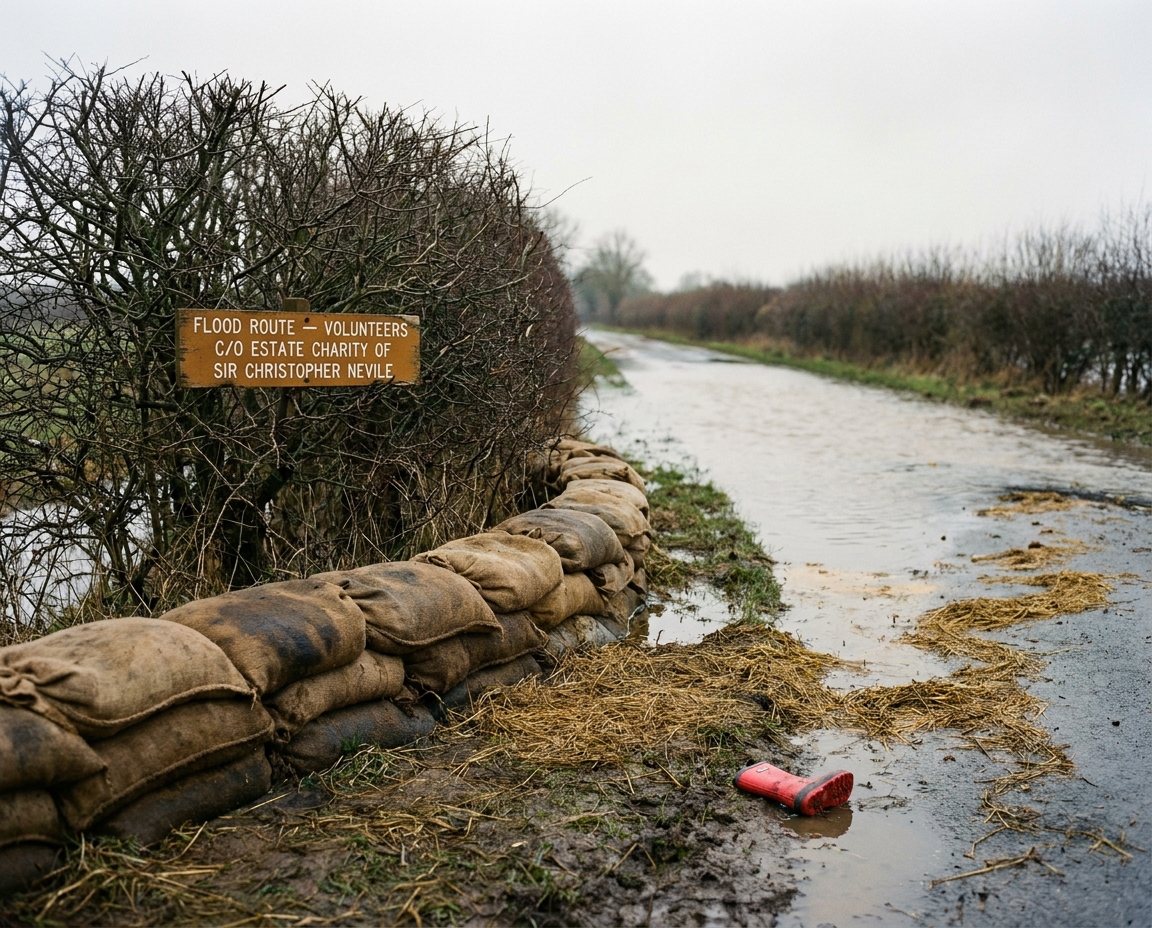
The River Witham came over its banks on the night of Friday 6 February 2026, between roughly nine in the evening and three in the morning. The flood bank built after the war held, in the end, where it most needed to hold. But the lane that runs east of Aubourn was under nine inches of water by Saturday morning, and four properties along the river end of Church Lane took water into their ground floors. The village hall stayed dry by inches; the Old Vicarage, by feet.
This note is not about the flood. It is about what happened to Quiet Hour — our smallest programme by spend, the one that pays for the cup of tea and the lift to the surgery — in the four weeks afterwards.
How Quiet Hour usually works
Quiet Hour is not a service we deliver. We do not have a befriending team. The visits happen because someone in the parish is already going — a neighbour, a member of the church congregation, a former colleague, a daughter or son who lives an hour away and drives over on a Sunday. The charity pays the small running costs that make those visits sustainable: a befriender's petrol money, a taxi to the surgery in Witham St Hughs, a contribution toward a Sunday lunch at the Royal Oak, occasionally a hairdresser's home visit. The total annual spend on Quiet Hour is around £200, spread across six or seven older parishioners who would otherwise see almost nobody between Tuesday morning and the following Sunday.
What changed in February
On the Saturday after the flood, I walked the river end of the village from ten to one. I had two of our Quiet Hour households on the river side of the lane. Both were dry, by luck rather than design. But three other households I had not previously had on the list — two of them widows in their early eighties, the third a couple in their late seventies — had taken water into the back of the kitchen and their downstairs power was off. None of the three was on our usual visiting circuit, because none had asked. Two had said no when an earlier rector suggested it, some years ago. The third had not been suggested.
The trustees met in an unscheduled half-hour at the village hall on the Monday evening. We agreed three things. First, that the budget for Quiet Hour for February and March would be doubled, drawing on reserves. Second, that for the duration of the recovery — taken in the minute book to mean six weeks — Quiet Hour would extend to any older parishioner whose ground floor had taken water, irrespective of whether they had previously been on our list. Third, that we would deliberately ignore the unwritten rule that the visits should follow a request from the household. The point of Quiet Hour is to be there before the request is made, but it had taken a flood to remind us.
The flood did not change the work. It clarified it. Quiet Hour is for the kettle being on at a quarter to four, when the day has been long and a neighbour has not come round for a week. From Lynne Rocks' note to the March trustee meeting
What the small purse paid for in the four weeks afterwards
- £28 across two weeks for a community-nurse friend's petrol to one of the widows' back doors three afternoons a week, while the downstairs dryer was running and someone needed to make sure she had not unplugged it again to boil the kettle.
- £18 for a hairdresser's home call to the same household — the appointment she had booked at the salon in Bassingham had been cancelled because the road was still closed.
- £35 across the four weeks toward Sunday lunches at the Royal Oak for the couple in their late seventies, with a neighbour, after their freezer had been written off.
- £22 for taxi fares (in our usual mileage-rate arrangement with a local driver) to the GP surgery for two follow-up appointments for one of our existing households whose son had been due to drive her but could not get across the flood-closed lane.
- £14 for two visits to a Wednesday-morning Aubourn Hall garden open day, with a befriender, in late March — the household had not been out beyond the gate since the Friday of the flood.
What we learnt
Three things, in no particular order.
The first is that we had been undercounting our reachable parishioners by at least three households, and probably more. The flood gave us an excuse to walk to back doors we had not previously walked to. We mean to keep doing that, with no other excuse than that the kettle ought to be on.
The second is that Quiet Hour works best when it pays for what is already happening. We did not, in any of the cases above, send a befriender who was not already going. We paid the costs of the visit so the visit could continue. That is the right shape of the work.
The third is that the £200 annual budget is too low. We are increasing the Quiet Hour budget to £350 for the 2026–27 financial year and we will keep the door open to drawing further on reserves in a year with another flood or another hard winter. Susan Stentiford, who keeps half an eye on our reserves policy, has confirmed the increase is sustainable.
A word of thanks
To the three churchwardens at St Peter's who walked the lane with me on the Saturday and the Sunday; to the licensee of the Royal Oak who fed two of our households free of charge on the Saturday evening; to the local taxi driver who refused to charge for a fortnight of fares — thank you. The £117 we spent through Quiet Hour in February and March would have been £400 without you.
If you would like to give to Quiet Hour, please mark your donation 'Quiet Hour' and we will keep it for the same purpose. If you would like to be on the kettle list — to be one of the back doors we walk to — please write to me directly.
From a small kitchen on a slowly drying lane,
Lynne Rocks, trustee