
To spend a small endowment carefully on the parish it was left to.
No more, no less. We are not in the business of campaigns, nor of replacing the state. We are the local pot to which a neighbour can quietly turn when an unexpected month falls hard.
What the Charity Commission records us as doing — and what that means in practice.
The Charity Commission for England and Wales lists our purposes under four headings: general charitable purposes; the advancement of health or saving of lives; disability; and the prevention or relief of poverty. Our recorded beneficiary groups are children and young people, elderly people, and people with disabilities. We are recorded as a charity that 'makes grants to individuals', and our recorded area of operation is Lincolnshire.
In practice that means we take an enquiry from a churchwarden, a head teacher at the local primary, a community nurse, a parish councillor, the licensee of the Royal Oak, or — most often — the household themselves; we ask one or two careful questions; and we either pay a small grant or we don't. We do not run programmes ourselves. We do not employ anyone. We do not provide casework. We pay other people for things the household needs, or we pay the household directly. We try to do it within ten days. For an emergency we try to do it within one.
The work is recognisably small. The two endowed funds together yield a few hundred pounds of investment income a year, and small donations from old friends of Aubourn add a few hundred more. In a typical year we will spend somewhere between £1,200 and £2,000 across roughly twenty-five to thirty-five household-level decisions. The size of an individual grant ranges from £20 (a taxi fare to a hospital appointment) to £500 (a contribution towards a stair-rail or a kettle-tipper). Most grants are between £40 and £250.
A short diagram of how a small endowment turns into a kettle that boils.
We do not believe in long theories of change at parish scale. Here is the whole of ours, in three blocks.
01 · A neighbour asks
Directly, by telephone or by note through the door of the Old Vicarage; or via a churchwarden, a head teacher, a community nurse, the village hall committee, or another trustee.
02 · Two trustees decide
For routine grants up to £250, the Chair and one other trustee may approve between meetings, in writing. For larger grants, the question waits for the next quarterly meeting at Aubourn Village Hall.
03 · We pay
Direct to the household by bank transfer, or to a supplier (plumber, joiner, garage, college) on the household's behalf. Always with a short hand-written note. Always with a follow-up in a fortnight to check the kettle is boiling.
Seven sentences that should not need to be written down.
We have written them down anyway, for the next generation of trustees.
- One parish, properly known. The endowment was left for Aubourn with Haddington. It is not for us to be generous with someone else's money outside the donor's intention.
- No fuss. We do not photograph beneficiaries. We do not publish a first name without permission. We do not turn a hardship into a press release.
- Quickly when it matters. A broken boiler in January cannot wait until the March meeting. Two trustees can act between meetings.
- Plainly written. Every grant letter is a side of A4 in plain English. Every account is signed off in the same kind of language.
- Patient with the capital. The endowment will outlive every present trustee. Our job is to spend the income carefully and to leave the capital steady.
- Hands off other people's work. We do not duplicate what the parish council, St Peter's, the village hall committee or Lincolnshire Community Foundation already do. We sit alongside, not in front.
- Honest about size. We are tiny. We say so. We will turn down an enquiry that lies outside our scale or our scheme of administration, and we will say where else to ask.
A thing we tried, and stopped, because it did not work.
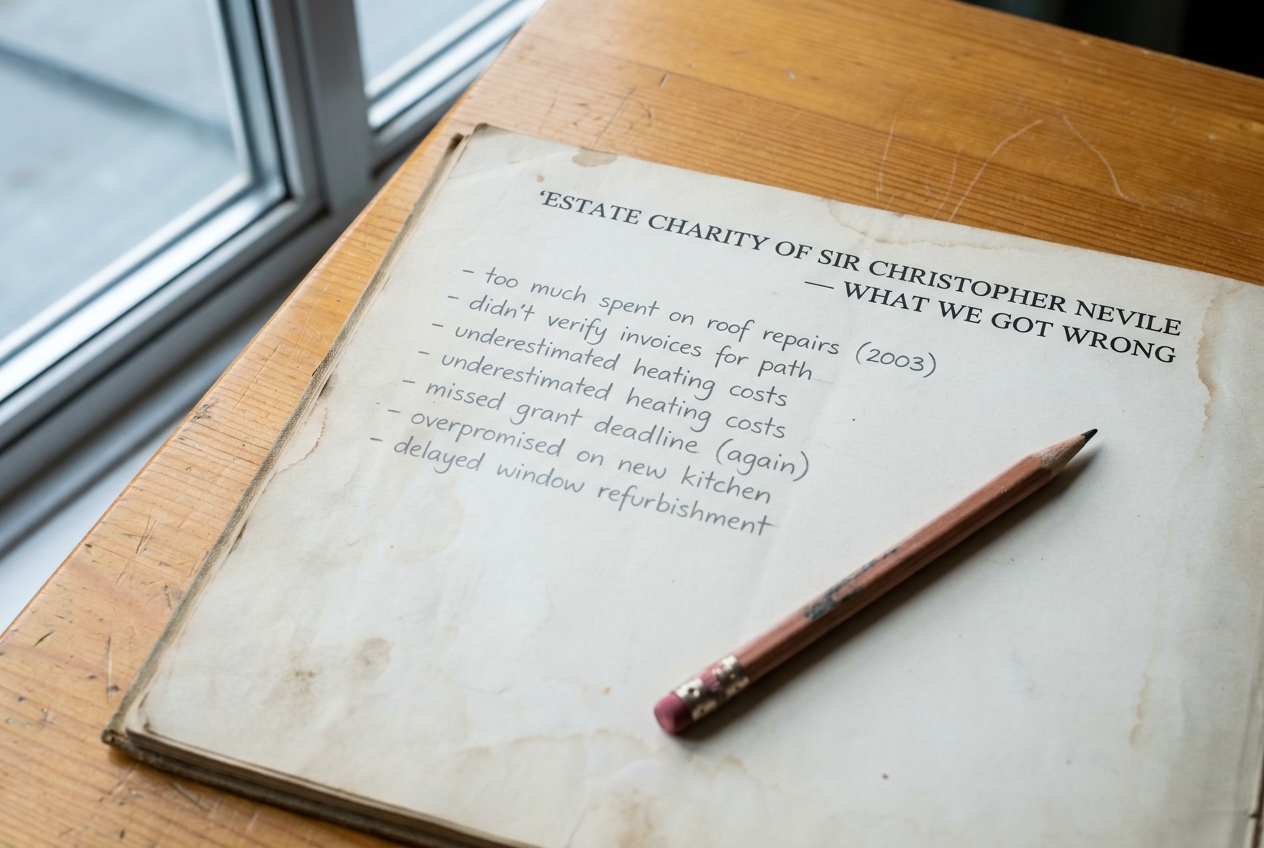
Between 2018 and 2021 the previous board piloted a small 'parish grants' application form — two sides of A4, with eligibility criteria, declarations and a returnable envelope. The idea was to make the process feel less personal, and to reduce the chance of bias in who got asked and who didn't. In practice, it had the opposite effect: it filtered out exactly the older parishioners and the more reserved households we most wanted to reach, and it favoured those already comfortable with written applications. Twenty-two grants were paid out across that three-year period — well below the trustees' expectations.
In 2022 the new board, under Jill Hughes, retired the application form and went back to grants made on word of mouth and visit. We are aware this introduces a different kind of bias: it favours households known to a trustee, a churchwarden or a head teacher. We try to compensate for it by holding a monthly surgery at the village hall and by writing twice a year to the rector of St Peter's, the head of Aubourn Primary, and the practice manager at the nearest GP surgery to ask whom we might be missing.
It is not a clean solution. We do not pretend it is.
We are not in the business of fixing the country. We are in the business of paying a plumber on a Sunday afternoon for a neighbour who has run out of options. From the Chair's introduction to the 2024–25 annual report
Read about our four programmes, or come to a trustee surgery.
Programmes are described in their own pages with named beneficiary types and a short note on geography. Surgeries are the first Saturday of the month, 10.00–12.00, at Aubourn Village Hall.